Cook the recipes our grandmothers never wrote down, with exact measures — and stop guessing.
Most of us have saved reels and forwarded messages that disagree about the amounts. Few realise the problem was never the cook: these recipes were simply never set down properly, with the measures, the method and the source.
It was never you. Nobody wrote the measures down.
In many kitchens there was an Ayeeyo setting a pot going while she talked about something else. A Nani reaching into the spice tin without looking. A handful of this. Some of that. Never a spoon, never a scale.
Now picture a worktop, a jar in your hand and a phone open beside it. One saved reel says one amount. A forwarded message says another. A third clip says "just add some" and moves on.
So you guess. You make it the way you think it went, and you are never quite sure. Or you put the jar back on the shelf and make something you already know how to make.
The reason is plain and practical. Nobody wrote the amounts down, so there is nothing to follow: no spoon measure, no time, no sign in the pan that says it is ready. A clip can show a dish once, but it cannot hand you the numbers to make it again.
Underneath sits something bigger than a missing teaspoon. A jar of black seed or a tin of turmeric is only an ingredient until someone gives you the amount, the time and where the practice comes from.
It is not your fault. Nobody handed you the measures, because the measures were never put on paper. So how does something so ordinary go missing? It begins in the kitchens themselves.
The recipes were never lost. They were never written down properly.
There was a time when this knowledge was simply part of the day. Dates sat in a bowl on the table. Barley, honey, milk and black seed lived on a shelf within reach. Nobody called it a skill. It was just how a kitchen ran.
It travelled from hand to hand. You stood beside the person at the stove, you watched, you tasted, and you were told "a bit more". The recipe lived in the cook's hands, and it passed on the only way it could: by being there.
Then households spread out, and fewer of us stood beside that stove. What had never been put on paper had no way to travel. The measures stayed in the hands that knew them. What reached us was fragments: a name, a rough idea, a saying passed along with no source attached.
We tried to fill the gap. The classic books say what was used, but rarely how to make it, and the print is dense and small. The modern booklets often give no references at all. And the reels and forwarded messages contradict each other, so you can never tell which one to trust.
That is the realisation. These recipes were not lost. They were never written down properly. What was missing was one page with the measures, the method and the source, written for a kitchen where you actually cook.
That page now exists, and it follows one simple pattern on every recipe. It is called The Three-Line Method.
The Three-Line Method: three lines under every recipe
Lists tell you what was used. Clips show you a cook who never says how much. The Three-Line Method answers the three questions you actually ask at the worktop: how do I make it, where does it come from, and how firm is that source? Because every recipe follows the same pattern, you never have to wonder what is missing.
Line one: how to make it
Ingredients in millilitres and grams, numbered steps, the time each one takes, and what the finished dish should look like when it is right.
Line two: where it comes from
The collection and number for Prophetic reports, so you can look each one up on sunnah.com and Quran.com. Family traditions are labelled as family traditions and never attributed to the Prophet.
Line three: how strong the source is
The grade printed plainly: Sahih, Hasan or Da'if. Weak sayings are clearly marked as weak, so you always know which is which before you pass it on.
What you will find inside
- The inspection to do before a single date goes into the jar for the overnight soak, and the 8–12 hours it then stays covered.
- The thumb-and-finger test that tells you whether your dates are ready to chop for hays, before you waste the butter.
- How to know haldi doodh is ready: steady steam, a gentle movement under the surface, and never a boil.
- The exact pinch of turmeric for one mug, measured in a level quarter teaspoon, so the colour comes out golden and even.
- Why Somali ginger tea keeps the ginger unpeeled, and the simmer-then-steep rhythm that makes the fragrance clear when you lift the lid.
- What "Ayeeyo" means, and why the page names the family tradition behind a recipe instead of hiding it.
- The six-jar spice shelf: where to put a newly bought spice so the older jar is always the one you reach for first.
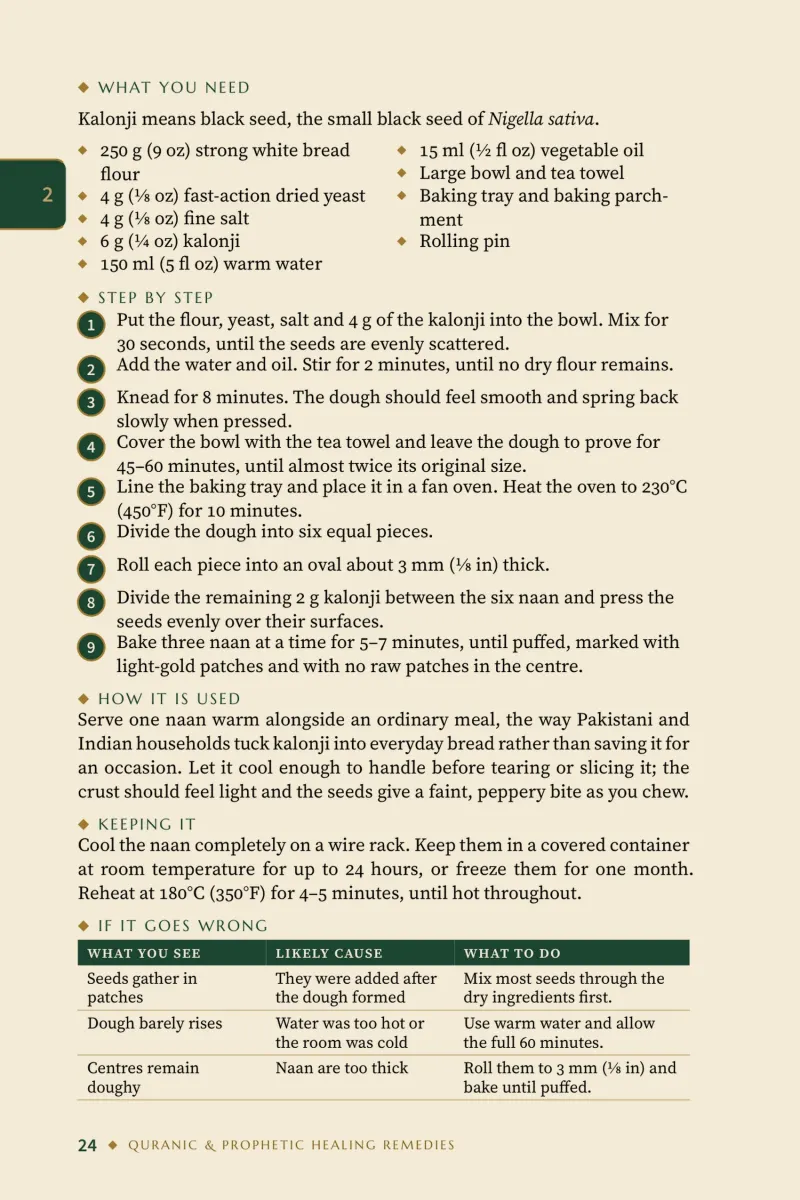
- Six small kalonji naan, with the black seed divided two ways (part kneaded through the dough, the rest pressed over the top before baking) and the dough test that tells you, by how it springs back slowly under your finger, that it is ready before the oven.
- Hays in twelve equal portions, and the one test that tells you the mixture will bind without turning greasy.
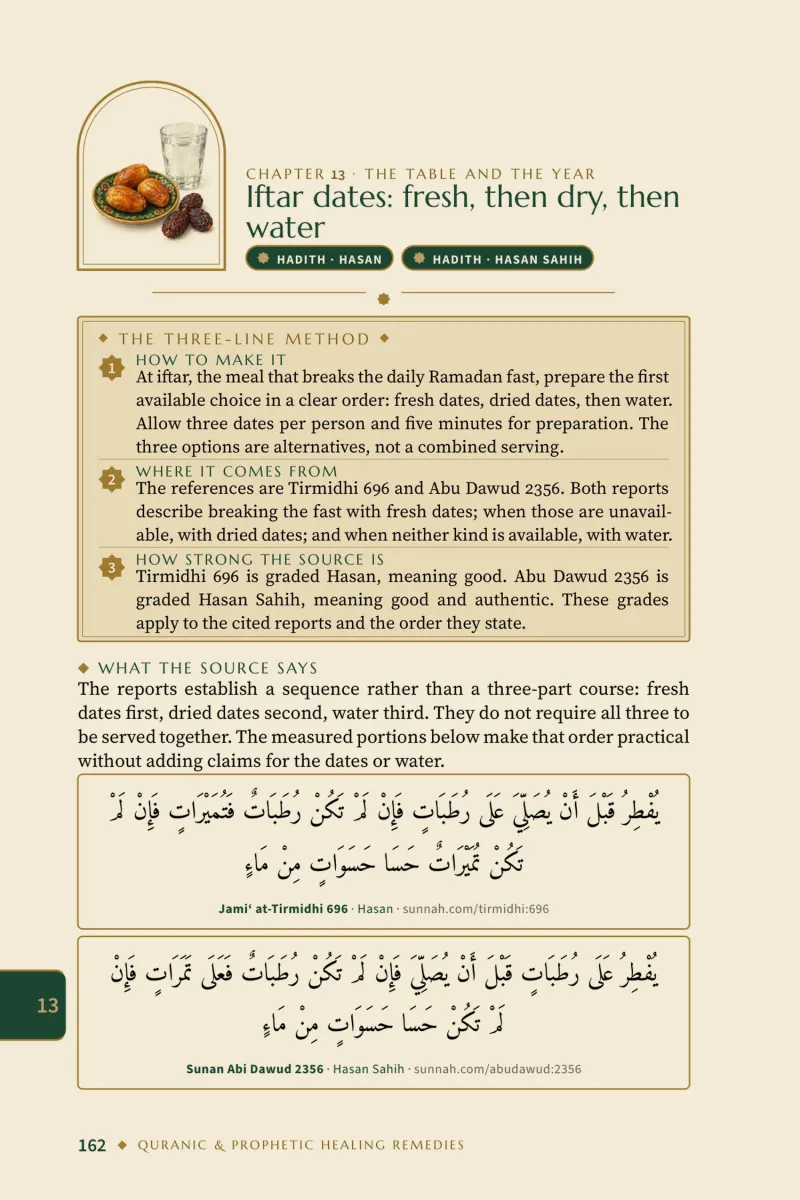
- The iftar order of dates: fresh, then dried, then water. It is three alternatives, never a combined serving.
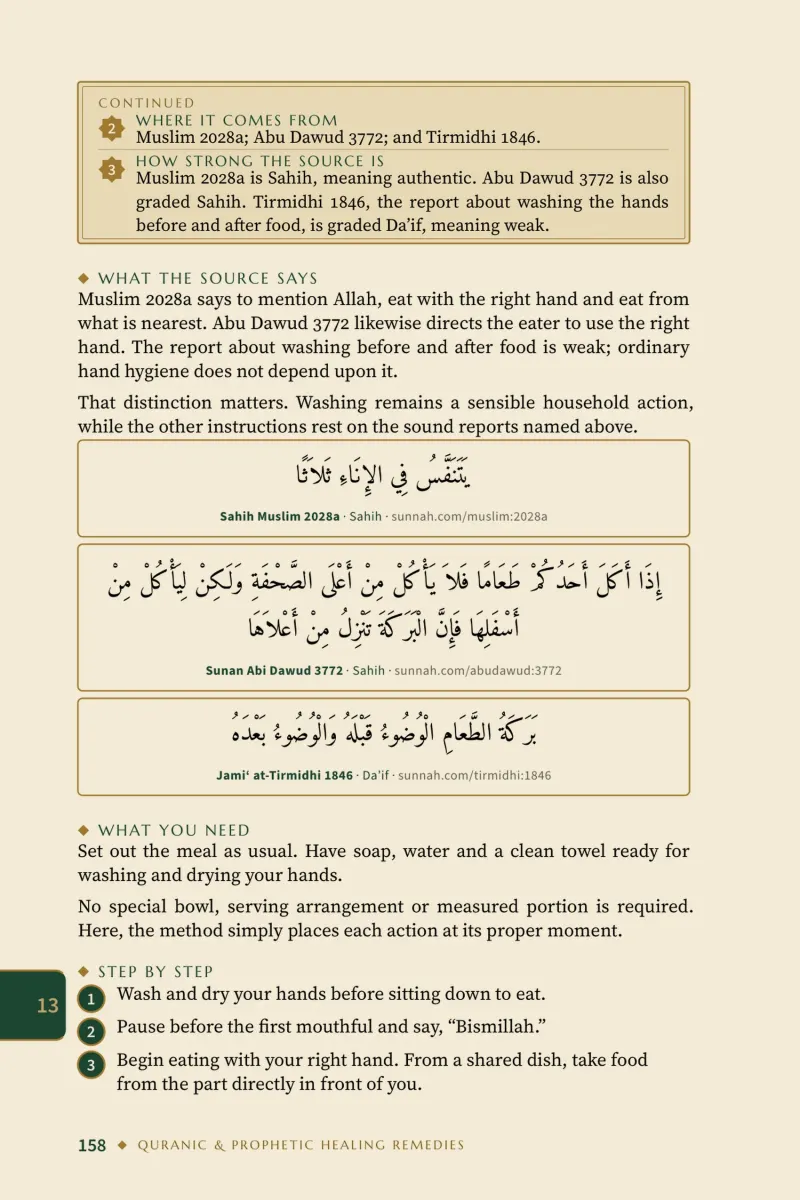
- Three table habits, and the one that the hadith collections grade as weak, marked so you never pass it on as firm.
- How to read Sahih, Hasan and Da'if in one glance, and how to read the source line on any recipe, with where to look a printed reference up yourself: sunnah.com and Quran.com.
- The family recipes labelled as family tradition: honest about where they come from, and never dressed up as something they are not.
- A section at the back on the sayings you will hear that are weak, and how to tell a weak saying from a family tradition.
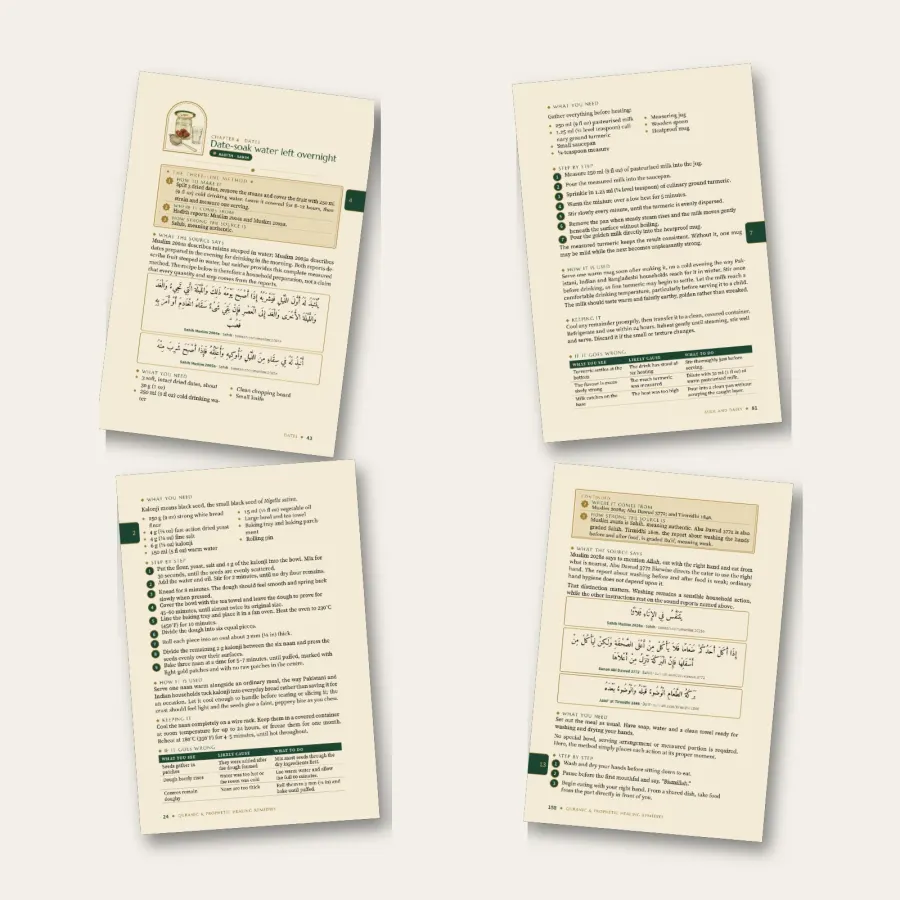
Here are eight pages from inside the book, exactly as they are printed.
Eight pages from the book, as printed
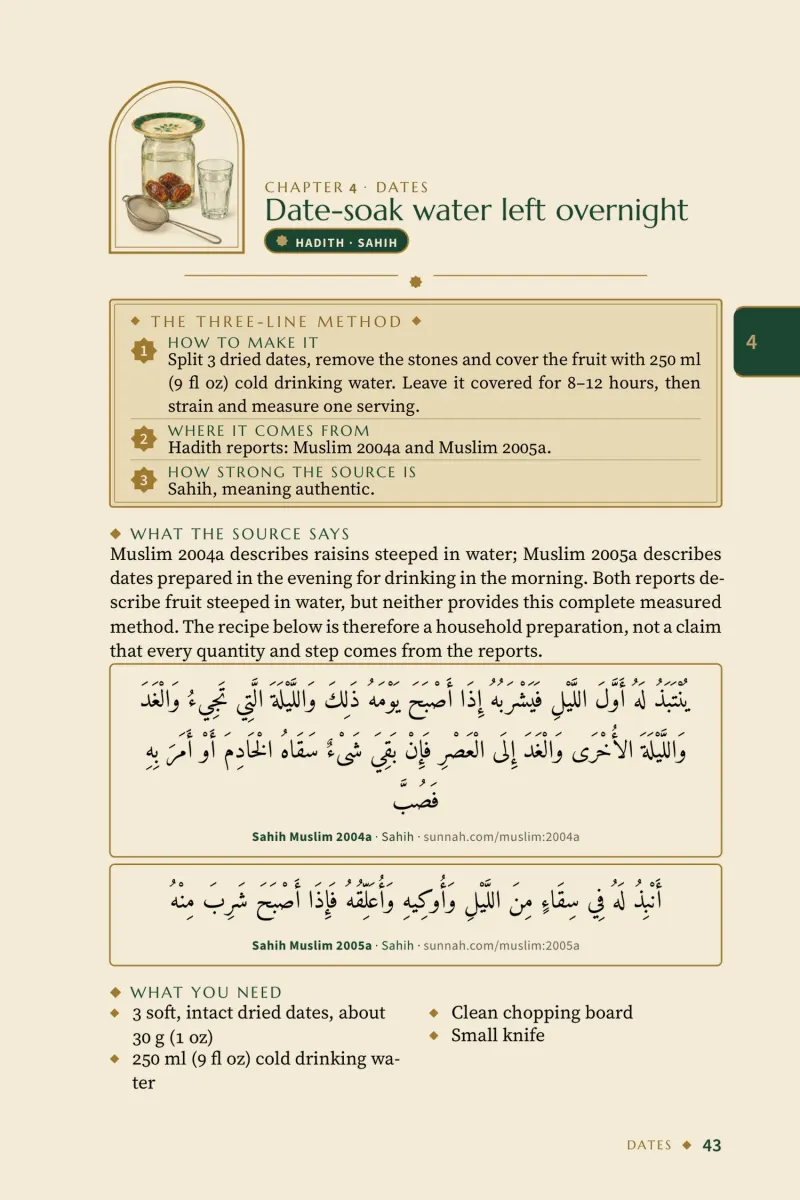
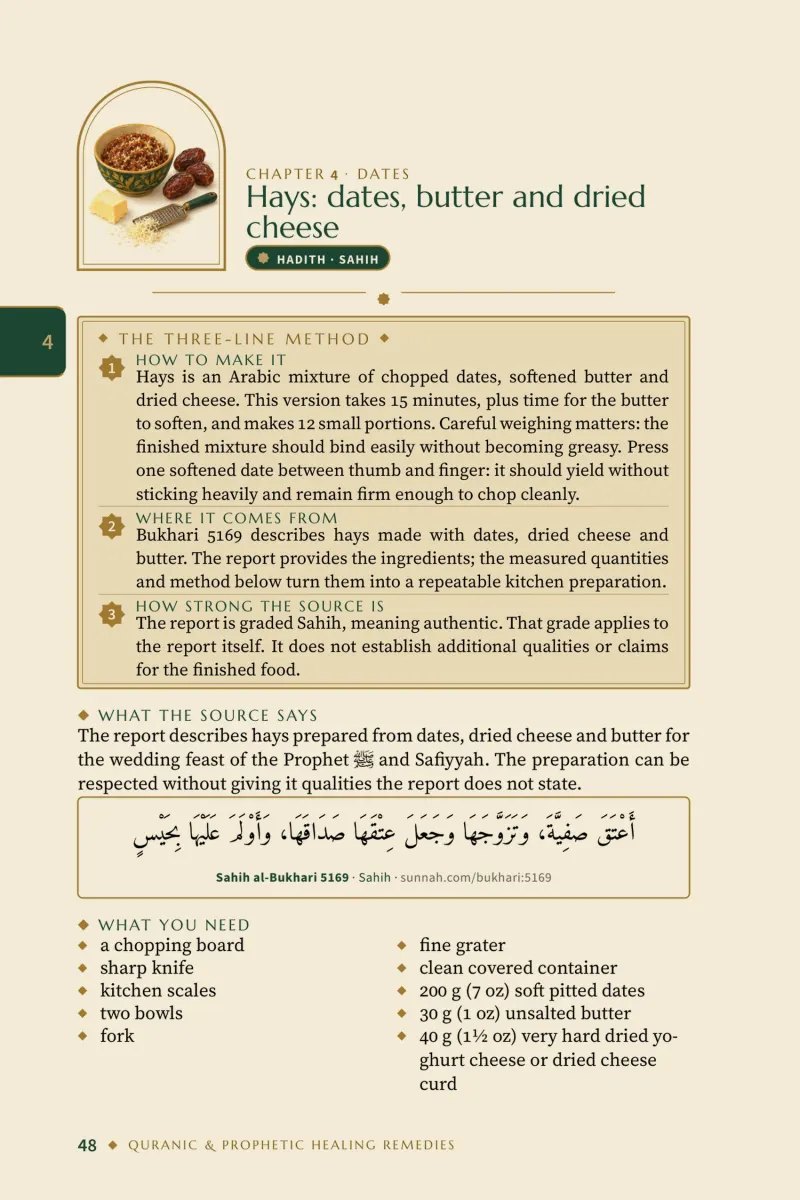
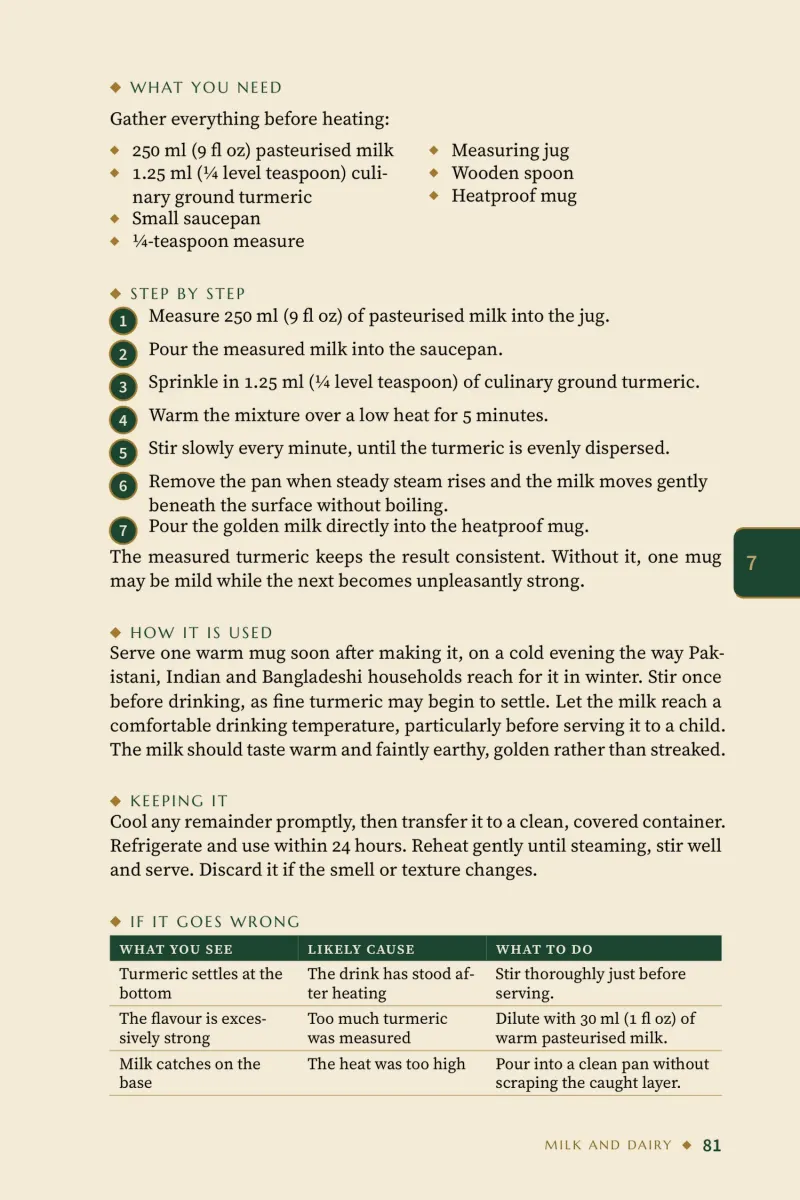
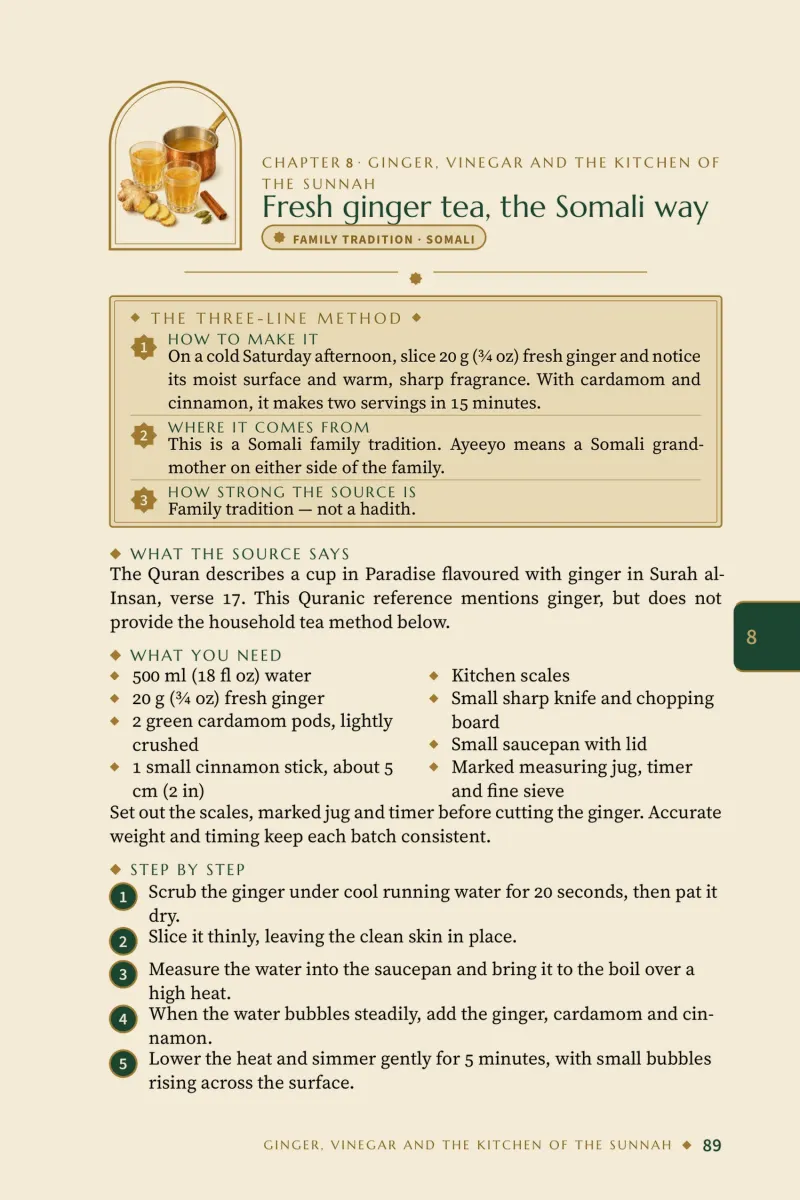
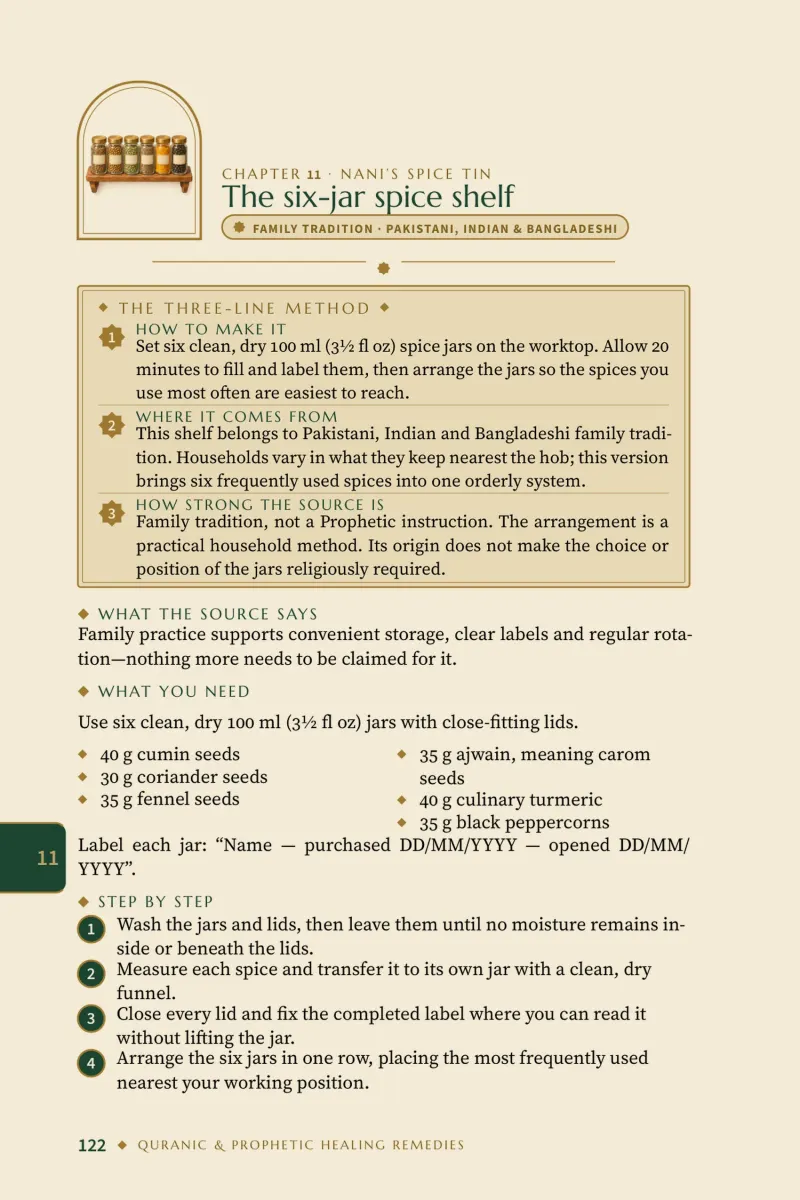
Read them as you would in your kitchen. Each recipe opens with its three lines: how to make it, where it comes from and how strong the source is. That is The Three-Line Method at work.
 Inside the book
Date-soak water left overnight
Three dates, a clean jar and a quiet night: the exact water measure and the hours it takes.
 Inside the book
Hays: dates, butter and dried cheese
Twelve equal portions, and the one test that tells you the mixture will bind without turning greasy.
 Inside the book
Haldi doodh: golden milk for winter nights
Eight minutes, one measured pinch, and the sign in the pan that says it is done.
 Inside the book
Fresh ginger tea, the Somali way
A family tradition, named as one, with the simmer and the steep timed to the minute.
 Inside the book
The six-jar spice shelf
Twenty minutes to set six jars in an order that keeps the older spice at the front.
 Inside the book
Kalonji naan: black seed where it belongs
Six small naan, and the seeds split between the dough and the surface.
 Inside the book
Iftar dates: fresh, then dry, then water
A simple order with two sources, each printed with its grade.
 Inside the book
Three table habits from the hadith books
Three habits, three sources, and one of them honestly marked as weak.
A real book on the worktop beside the hob
188 pages, 6 x 9 inches (15.2 x 22.9 cm), printed in full colour on cream paper, with 75 gouache illustrations. No screen to wake, no scrolling to find your place, no clip to rewind. When the recipe is on the worktop, the measures are in front of you from the first step to the last.
| Size | 15.2 x 22.9 cm (6 x 9 in) |
| Pages | 188 |
| Formats | Hardcover or paperback |
| Inside | Full colour, 75 gouache illustrations, on cream paper, printed in Britain |
A printed page on the worktop is one thing. But you may well be wondering whether a free clip online would do the same job.
But can't I just look it up online?
You can, and there are some good free clips out there. The difficulty is that each one is a different cook, with different amounts, and no common way to see where it comes from.
| The book | Free clips online | |
|---|---|---|
| Measures | Millilitres, grams and spoons, every recipe | Often "some" or "a handful" |
| Source | Collection and number printed | Frequently missing or unclear |
| Source strength | Sahih, Hasan or Da'if shown | Rarely stated |
| Family tradition | Labelled as family tradition | Often mixed in with the rest |
| In your kitchen | On the worktop, no screen to wake | Phone locks, clip restarts |
| Checking it | Every reference you can look up | Varies from clip to clip |
A free clip can show you a dish once. A book keeps the same measures and the same sources there for the next time. So what does it feel like when that is back in your kitchen?
What it feels like to have it back
You cook it from the page, with the measures in front of you
No more standing at the worktop weighing up three contradicting clips. You read the amounts, follow the steps with their times, and the guessing stops.
The iftar and Eid table
Recipes for the iftar and Eid table, with the dates in the order the sources give and a drink made the night before.
The spice shelf is finally in order
Six jars in a row, the most used nearest your hand, the older spice always in front. You reach without looking, the way our grandmothers did.
You can pass it on and know where each recipe comes from
When the children ask where something comes from, you point to the line. Every recipe prints its source, and family traditions are marked as family traditions.
Who this book is for, and who it is not for
- This is for you if you have stood at the worktop with a jar in your hand and no idea how much to use.
- This is for you if you have saved a pile of reels and still do not know which one to follow.
- This is for you if you want every recipe with its measures, its steps and the time each takes.
- This is for you if you want to see the source and its grade printed, so you can look it up yourself.
- This is for you if you want family recipes kept as family recipes, honestly labelled and not dressed up as something else.
- This is for you if you want to hand the recipes on to the children in your life with confidence.
- It is not for you if you want a quick list of ingredients with no measures or method.
- It is not for you if you expect every recipe to come from the hadith collections: some are family traditions, and the book says so.
- It is not for you if you are looking for a book of religious rulings or school-of-thought debate: this is recipes and sources.
And what do other readers say once the book is in their hands?
What readers say about the book
[Reader reviews go here: real reviews from readers of the book, in their own words. Never invented.]
Get the book and the free gifts
A printed book on your worktop, opening onto the recipe you want and showing its measures, its method and its source. Beside it, an app that walks you through the recipes one step at a time, and printable pieces for your jars and your table. The recipes stop being half-remembered and become something you do.
For a limited time, The Three-Line Kitchen app and three printable PDFs come free with every copy.
 APP
APPThe Three-Line Kitchen
The recipes from the book, one step at a time, on phone, tablet and computer.
- The recipes from the book, one step at a time
- Works on phone, tablet and computer
 PDF
PDFThe Ramadan Kitchen
A PDF to download or print, made for the Ramadan table.
- [Details coming: final description from the gifts session]
- PDF to download or print
 PDF
PDFNani's Kitchen Labels
Labels ready to print at home for your jars and shelf.
- [Details coming: final description from the gifts session]
- Ready to print at home
 PDF
PDFThe Foods of the Quran Colouring Book
A colouring book ready to print at home, for the children at your table.
- [Details coming: final description from the gifts session]
- Ready to print at home
Choose your edition
Get the recipes back in my kitchenSecure checkout · Arrived damaged? We replace it free.DAY
The risk is ours, not yours
Read it, cook from it, try the recipes. If it isn't for you within 60 days, email us for a full refund.
Questions
What size is the book and what is in it?
It is 188 pages, 6 x 9 inches (15.2 x 22.9 cm), printed in full colour on cream paper with 75 gouache illustrations. It holds 61 recipes and kitchen traditions, each with its measures, method, source and grade.
How does delivery to the United Kingdom work?
Delivery in the United Kingdom is free and tracked, 3-5 working days.
What if it arrives damaged?
If it arrives damaged, email us and we replace it free.
I have never cooked from recipes like these. Is it for beginners?
Yes. Every recipe lists its ingredients, numbered steps and times, and tells you what the finished dish should look like. The Three-Line Method puts the same three lines under every recipe, so you always know where to look.
Is it written for readers in the United Kingdom?
Yes. Measures are in millilitres and grams with ounces and fluid ounces beside them, oven temperatures are in °C with °F, and there is a section on where to buy ingredients in the UK. It is written in British English.
Can I give it as a gift?
Yes. It is a book for the kitchen and the table, and it suits anyone who cooks from recipes. The Ramadan Kitchen PDF is also included in the free gifts.
What are the free gifts?
The Three-Line Kitchen app, plus three printable PDFs: The Ramadan Kitchen, Nani's Kitchen Labels and The Foods of the Quran Colouring Book. They come free with every copy for a limited time.
Is this a medical book?
No. It is a book of recipes and kitchen traditions, each with its source. If you are pregnant or breastfeeding, take prescribed medication or cook for a baby, ask your GP or pharmacist first: each recipe flags its common cautions.
Two roads from this worktop
You can carry on as you are: another saved reel, another amount that does not match the last, another jar put back unused. Or you can have the recipes in front of you, with the measures, the method and the source on one page.
To take the second road, press the button below, choose your copy and check out. The book comes printed in Britain, and the app and the three printable PDFs come with it free for a limited time.
The risk is on us. Open the book in your own kitchen and see whether the pages do what we say. If they do not, our guarantee puts it right.
Get the recipes, measures and sourcesLimited-time offer: app + 3 printable PDFs free